How Optical Materials Shaped Two Centuries of Lens Design
The history of lens design is usually told as a history of clever geometry. People concentrate on Petzval’s mathematics, Rudolph’s anastigmats, or Bertele’s cemented groups. That is a correct account, but it is not the complete one. Nearly every one of those breakthroughs happened because a glassmaker handed a designer a material that had not existed before. The geometry was frequently downstream of the glass that happened to be available. Chemistry, more often than mathematics, was the factor that limited progress for centuries.

Let’s say a lens designer addresses an optimization problem. They must reduce several aberrations by adjusting a specific set of variables, including radii, thicknesses, air spaces, and glass types. For most of history, the glasses that were available occupied only a small region of the Abbe diagram, which plots refractive index versus dispersion. When a new glass family appeared in a previously empty section of that map, designers obtained a new independent variable. Problems that were mathematically impossible using old materials became solvable with the new ones. The history of optical glass is the history of designers acquiring greater flexibility.
We will begin with the background theory before getting into the start of that development.
Part One: Crown, Flint, and the Cooke Triplet
Why Do We Care About Glass Material Anyway?
First of all, what does glass do? When light rays pass through the air, or through a vacuum, into a medium with an index of refraction like water or glass, the light rays bend at the boundary line, and refracts. This is Snell’s Law. In fact, this was a phenomenon that was documented back in the Greek days. Euclid stated that that you can see an object at the bottom of a cup once you pour water into it, among other observations about how sight and light interact.
Although refraction and reflection were known since ancient times, it wasn’t until the 17th century that an accurate representation of refraction was developed by Willebrord van Roijen Snell. Snell made graphical relationship that was mathematically accurate. René Descartes later expressed the same relationship using trigonometric functions, arriving at the familiar equation still in use today:
n sin(i) = n’ sin(I’)
Any fast lens or ultra-wide lens must follow this law, through multiple calculations in lens design software.
If I can make an attempt at explaining the equations verbally, it would mean that the product of the index of refraction and the sine of the angle of the ray is equal across the boundary of the index to the second medium. Two simple examples of this effect for lenses can be expressed with a convex lens. If we have two convex lenses that have the same shape but a different index of refraction, the lens with the larger index of refraction would bend the light more, and would have a shorter focal length, and larger lens power. If we have two convex lenses with the same focal length with two different materials, the lens with the higher index of refraction would have a smaller radius of curvature, or a stronger curvature.
Combining different optical materials, primarily glass but also plastic, can provide the optical designer a degree of freedom to fulfill the intended optical design. This piece is really about how those degrees of freedom expanded, one glass family at a time.
Before Crown and Flint
Glassmaking predates lens design by a large margin. It began in Mesopotamia and Egypt around 3000 BCE, but the first items were opaque or only slightly transparent, serving as beads and vessels instead of optical tools. Polished rock crystal and natural quartz probably acted as early magnifiers well before intentionally shaped glass was used. By the 13th century, improvements in furnace temperature regulation and batch composition in Venice, especially on the island of Murano, and in the Islamic world yielded clearer, more uniform glass than previously available. This increased clarity allowed the creation of wearable spectacles in Italy around the 1280s, marking the first well‐recorded use of shaped glass specifically to correct vision. Nevertheless, these early lenses were hand‐ground, varied in composition between pieces, and functioned without any defined optical parameters. No one was plotting refractive index versus dispersion in the 13th century. They simply ground glass until it appeared to help.
The invention of the refracting telescope around 1608 to 1609, followed shortly by the compound microscope, generated a need for lenses that contemporary glassmaking could not fully meet. Glass of that time contained bubbles and striae, exhibited streaky compositional inhomogeneities, and had high chromatic dispersion that no one yet possessed tools to correct. This era and its frustrations eventually led to Newton’s well‐known argument against refracting optics, which we will discuss shortly. What the period did establish, despite not solving the material issue, was lens grinding and figured polishing as true crafts, preparing the way for material science to later catch up.
Crown and Flint: The Only Two Options
Crown glass possessed a refractive index ranging from 1.50 to 1.53 and an Abbe number ranging from 58 to 65. Such a high Abbe number signifies low dispersion. Dispersion measures how much glass separates different light wavelengths when it refracts them. Low dispersion aids in correcting colour problems but offers limited ability to bend light.

Flint glass featured a higher refractive index ranging from 1.60 to 1.75 and a lower Abbe number ranging from 20 to 40. These values indicate high dispersion. Flint glass bent light more strongly than crown glass, yet it produced greater colour separation.
Designers could work only with these two materials. Nevertheless, these two choices enabled a major advancement in optics.
John Dollond patented the achromatic doublet in 1758. The design paired a positive crown element with a negative flint element. When used alone, each element separated light into colours, the most basic form of chromatic aberration. We can see this acutely when we place a prism in white light like sunlight. When combined in particular proportions, the colour‐spreading effects cancelled each other while the focusing power stayed the same. This enabled a lens to bring two different wavelengths of light to a single focal point. The invention corrected chromatic aberration, the colored blur that had affected telescopes and microscopes since their inception.
This development altered the field of optics. In his 1672 book Opticks, Isaac Newton claimed that chromatic aberration was an inherent flaw of refraction that could not be corrected. Newton correctly deduced that white light was not a single colour but a combination of multiple colours, and that the colours separate into a spectrum because each colour experiences a different index of refraction. We call this dispersion today. Due to this belief, he ceased work on refracting telescopes and instead built a reflecting telescope (This is why telescopes named Newtonian telescopes are reflective and Galilean telescopes are refractive). Dollond disproved this theory because his crown and flint glass achromat possessed sufficiently different dispersion levels to permit colour correction.
This solution imposed a particular limitation on lens design for the following 150 years. Relying on only two glass types to correct colour issues gave designers few options for tackling other problems. Spherical aberration, coma, astigmatism, field curvature, and distortion stayed largely uncorrected. Photographic lenses of the 19th century reveal which of these errors the designer chose to permit. Having only two glass types made it impossible to correct every error at once. In general, a smaller curvature has fewer aberrations, so using higher index materials are beneficial for faster lenses, for example. Although it doesn’t mean that lower index glass are inferior, depending on the lens type and lens form, lower index lenses are welcomed. The point is, in these times, Designers could not produce lenses that were fast, wide‐angle, and sharp across the whole frame. They had to select one or two of those qualities and accept the remaining distortions.
Fraunhofer Turns Glassmaking Into a Science
Joseph von Fraunhofer was the first individual to tackle this bottleneck. He worked as a glassmaker instead of a lens designer.

While a teenage apprentice in Munich, Fraunhofer lived through the collapse of his workshop. He was pulled from the debris, and the patron of his rescuer funded his education. He later transformed glassmaking from a craft reliant on secret family recipes and trial and error into a reproducible science. In 1814, he defined exact batch formulas, melting procedures, and annealing schedules. These techniques eliminated the bubbles and striae, also known as streaky compositional inconsistencies, that had plagued glass for centuries. His crown and flint glasses became more consistent and clearer than earlier versions.
Fraunhofer also identified the dark absorption lines in the solar spectrum. This finding needed high-quality glass because fine spectral lines cannot be seen through prisms that contain striae. Scientific demands prompted material improvements, which subsequently benefited other technologies. For instance, the Dollond achromat was patented decades earlier but failed commercially due to poor glass quality. It turned into a reliable product only after Fraunhofer-quality glass was available.
Even with these improvements, a fundamental limitation persisted. Improved versions of crown and flint glass were still merely crown and flint. The options available had higher quality, yet the range had not expanded. Another seventy years were needed before further progress occurred.
Coffee Break. What is really interesting to me is the development of the telescope, which was a time before Snell’s law was made public. The early telescope was made in 1608, and Galileo took interest and developed the first working model in 1609. Snell’s law was found in around 1620, and the public found out about it about a decade later. Telescopes were exported in droves back then, even making it to samurai era Japan in 1618. Kepler made public his work on refractive optics in 1611, and Kepler himself did not understand Snell’s law. But Kepler looked into the phenomenon intently, and found that under 30 degrees, the incoming ray angle and outgoing ray angle was roughly proportionate. I suppose this was because sin(i) is proportional to i at low angles. So it was in the paraxial domain. My point is, I really like that the people who discovered the usefulness of telescopes went forward with their innovation without completely understanding the theory. It is like going to another country and using the local language without perfectly understanding the grammar. Your speech can be grammatically incorrect, but you can communicate with the locals, without waiting to experience all the wonderful things by perfecting your grammar.
The Jena Collaboration: Abbe, Schott, and a Map With Empty Regions
Optical glass and prisms are not are not the same glass you see for windows, vases, and cups. Optical glass is homogeneous across the medium, and the index of refraction control is very high quality. In order to create these materials, various types of oxides are mixed together for extremely high precision. Since the rays passing through these materials cannot change, so no bubbles or striae are acceptable. Traditional clay crucibles can create very good materials, but even then, the yield could be around 50%.
By the 1870s, Ernst Abbe was working as a physicist for Carl Zeiss’s company in Jena. He created a mathematical theory of optical imaging that let him specify the precise criteria for perfect lens correction. Comparing the glass types then available with his theoretical criteria, he found a problem. Every glass then known fell on a single curve when refractive index was graphed against dispersion. A high refractive index always meant high dispersion, and low dispersion always meant a low index. No material could depart from that curve. The glass his theory demanded, which would have both high refractive index and low dispersion, was not present. Abbe could not finish his designs because the required materials had not yet been created.
Abbe looked for a person capable of producing those materials. He found Otto Schott a young chemist who was independently testing unconventional glass recipes. Schott had not yet identified a practical application for his experiments. Abbe invited him to Jena. In 1884, Abbe, Schott, and Carl Zeiss established a glassworks later called Glaswerk Otto Schott & Genossen. This enterprise was the first to concentrate solely on research‐grade optical glass rather than making glass as a by‐product of other industry.
Schott employed a new approach. He avoided modifying the usual crown and flint glass formulas. Rather, he altered the oxide composition of his glass melts in a systematic way. He introduced boron, barium, lead and other elements to assess how each one changed refractive index and dispersion independently. This portion of the history is especially satisfying to me. Schott found that the correlation between high index and high dispersion was not a physical law. It stemmed only from the restricted chemistry available up to that point. It reflected a limitation of earlier experiments.
Barium crown glass glass was the key breakthrough. It provided a new combination of properties: a refractive index that exceeds that of standard crown glass while still maintaining a relatively high Abbe number, which signals low dispersion. On the Abbe diagram, this glass lies off the old curve. It occupied a portion of the graph that had previously been empty.
This alteration affected lens design right away. A positive lens element made of high‐index barium crown could deliver the same optical power as a standard crown element while requiring less surface curvature. Decreasing the curvature reduced the marginal ray angles and therefore lowered spherical aberration. Flatter surfaces also cut down coma. Designers were able to allocate optical power among elements in a different way. Some elements could bend more light without raising chromatic aberration. This simplified the control of astigmatism. It was not merely a matter of better glass quality. It gave designers a broader set of options. For a hundred years, certain aberrations had been coupled, forcing a trade‐off between them. Those aberrations could now be corrected separately.
By the 1880s, Abbe and Schott compiled these results into the first Abbe diagram. The diagram served as a map of glass types that plotted composition according to index and dispersion. It let designers select materials using data instead of trial and error. Modern glass catalogs continue to employ scatter plots of index and dispersion values. Those catalogs are direct descendants of the original map produced in Jena.

The Cooke Triplet Cashes In
All of this glass chemistry would have stayed a curiosity if no one had discovered how to apply the new design freedom to a real lens. This is where Harold Dennis Taylor enters the story.
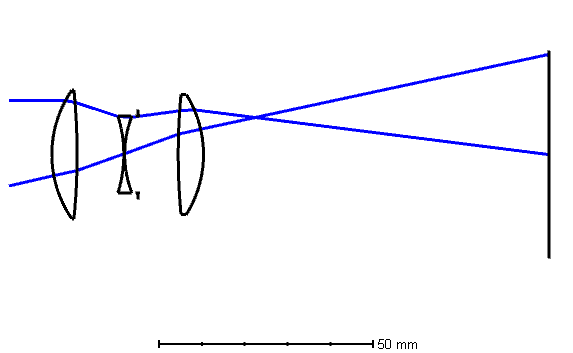
We covered Taylor and the Cooke triplet in some detail in the lens design forms guide and again in the Eras series, so we will not repeat the entire story here. Nevertheless, it is useful to revisit it with fresh eyes, since the triplet is essentially a glass story dressed in a geometric form.
Taylor’s 1893 design comprised two positive crown glass elements with a single negative flint element situated between them. These components were separated by air gaps rather than being cemented together. The system employed just three pieces of glass to correct all five Seidel aberrations simultaneously. Such a result could not be achieved with the crown and flint glasses that were available in Fraunhofer’s era. The design succeeded due to the broader range of glass types generated during the Schott revolution. Taylor had access to sufficient different index and dispersion combinations to balance spherical aberration, coma, astigmatism, field curvature, and distortion. He accomplished this by using only three elements and two air gaps as variables. This design was impossible to balance in 1860, yet became solvable in 1893. This was not necessarily due to Taylor being more intelligent than earlier designers, but because he had more materials at his disposal.
The Cooke triplet later became the direct ancestor of the Ernostar, the Tessar, and dozens of subsequent designs, precisely the lineage we outlined in the lens design giants series. Each of those descendants inherited the same fundamental reliance on glass variety that originally enabled the triplet.
Rudolph, the Protar, and the First Anastigmats
Paul Rudolph was the other principal beneficiary of the Jena glass revolution, employed directly at Zeiss while following Abbe’s theoretical guidance. In 1890, Rudolph employed the new barium crowns to create the Protar, the first lens that simultaneously corrected spherical aberration, coma, and astigmatism, a true milestone that we discussed in the lens names newsletter. These are glass names such as BaK, BaF, and SK. It is important to note the timing: Rudolph’s Protar appeared only six years after the Jena glassworks was founded. The chemistry preceded everything else. The geometry followed almost immediately once the chemistry enabled it. Rudolph did not need to wait a generation to use Schott’s new glasses; he worked alongside the individuals who produced them.

Filling In the Map
Barium crown represented the headline breakthrough, yet it did not conclude the narrative for this era. During the 1890s and into the early 1900s, Schott and his successors continued to introduce new compositions-dense barium flints, new borate‐based flints, and a series of higher‐index crowns that extended beyond the original barium formulations. Where the earlier Abbe diagram displayed a single curve, and later a curve with one useful region offset to the side thanks to barium crown, it now began to populate with genuine clusters of points distributed across the chart.
This was important for reasons that extend slightly beyond what barium crown alone could provide. When only one or two off‐curve glass families were available, a designer could separate refractive power from chromatic penalty, a capability that enabled the Protar and the Cooke triplet. However, secondary color effects-the finer‐grained mismatches in how various glasses disperse light across the entire visible spectrum instead of just two reference wavelengths-required a truly richer set of options to control effectively. The growing flint and crown families provided designers with additional means to balance lateral and axial color against one another, and to keep spherochromatism-the tendency for different wavelengths to experience varying amounts of spherical aberration-more tightly controlled. None of this resolved the secondary spectrum problem directly; that breakthrough remained decades away, and we will address it properly later in this piece. Nevertheless, it meant that by the turn of the century, glass selection itself had become a genuine design variable, something a designer actively considered rather than a fixed constraint to work around.
Around the turn of the century, lens designers possessed a genuinely useful catalog: crown, flint, barium crown, and a variety of new borate and high‐index formulations. The Cooke triplet and the early anastigmats demonstrated what could be achieved with this expanded toolkit. However, photographers desired something that the glass of 1900 could not yet fully provide: speed. Larger apertures, brighter viewfinders, faster shutter speeds in dim light. That demand would drive the next round of glass chemistry and the ensuing generation of famous lens names.
Part Two: The Race for Speed
The Double Gauss Problem
The Double Gauss concept is ancient, older than many assume. The Double Gauss itself dates to the 19th century, featuring a symmetric layout of two Gauss-type doublets positioned opposite each other around a central stop. However, the practical fast photographic variants linked to the name only appeared once designers accessed a far richer glass catalog, and the explanation is important to detail.
A fast normal lens requires strong positive power packed into relatively few elements, since each extra air‐glass surface adds another chance for aberrations (and, before coatings, another surface that loses light and contrast to reflection). In turn, strong positive power calls for either aggressive surface curvature or high‐index glass. Prior to the expanded glass catalogs of the early 20th century, “aggressive curvature” was the sole lever, and it carries a cost: larger marginal ray angles that directly increase spherical aberration and coma. Each attempt to speed up a Double Gauss design by steepening its curves incurred a penalty in image quality at the edges and corners.

By Paul1513 at en.wikipedia, CC BY-SA 3.0, Link
The Jena glass revolution, along with its early‐1900s refinements, altered that trade‐off.
When higher‐index crown glasses appeared in the exact combinations a Double Gauss design requires (strong positive menisci that avoid steep curves for their power), designers could distribute optical power across more elements while preserving symmetry, thereby reducing previously locked‐in aberrations. This allowed the format to advance steadily from modest apertures to f/2, then f/1.5, and finally f/1.4, without the edge image quality collapsing as it would have with 1880s glass. By the era when Paul Rudolph’s Planar variations and their numerous descendants matured throughout the 20th century, the Double Gauss had become, and arguably still is, the dominant architecture for fast normal lenses industry‐wide. Practically every 50mm f/1.4 or f/1.8 lens available today, irrespective of brand, descends from the Double Gauss design.
Bertele’s Different Bet: The Sonnar
Not everyone chasing speed took the Double Gauss route, though. Ludwig Bertele, whom we’ve spent a fair amount of time with in the Eras series and the lens names newsletter, made a different bet entirely with the Sonnar in 1929.
Not all who pursued speed followed the Double Gauss path. Ludwig Bertele, whom we have covered extensively in the Eras series and the lens names piece, placed a completely different wager with the Sonnar in 1929.
While the Double Gauss method employs numerous air-spaced elements to spread power gradually, Bertele chose the reverse: fewer air-to-glass surfaces, achieved by cementing groups of elements together into thick compound blocks. This was extremely important in a time before anti-reflection coatings were available. A rough calculation of glass-to-air loss is about 4%, called Fresnel loss. 4% might not seem like a big deal, but it adds up fast if there are eight glass-to-air surfaces. Also, each uncoated air-glass interface reflected a small fraction of incoming light backward, reducing image contrast and generating internal flare. A Double Gauss design, with its many separate elements, incurred this loss repeatedly. The Sonnar, by cementing elements into fewer effective surfaces, largely avoided the issue, which explains much of the reputation of Sonnar-derived lenses for superior contrast well into the coated-lens era.
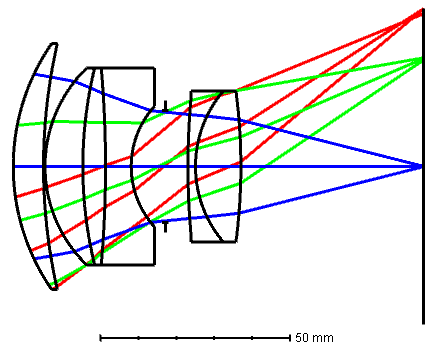
Ludwig Bertele’s Sonnar design, DE570983 (1931)
However, cementing elements into thick compound groups works optically only when the glass offers a sufficient range of refractive index and dispersion to make the combined group act as required. This is the same underlying dependency observed with the Double Gauss, merely applied to a different geometric solution. Improved high-index optical glasses allowed Bertele’s compound groups to deliver greater optical power per element, reducing the total number of elements required for a given aperture, and consequently enabling larger apertures without making the design unmanageably complex. The outcome was the f/2 Sonnar in 1929, followed by an f/1.5 version, each providing excellent contrast for their era precisely because the glass allowed Bertele to address the speed problem with a fundamentally different structural strategy than his Double Gauss rivals.We discuss this rivalry in much greater detail in the Double Gauss vs. Sonnar comparison post, if you want the complete geometric breakdown.
I wish to stress a point that the geometry comparison does not fully explain. Two designers employed the same expanding selection of glass types to devise different architectural solutions for the same problem. This shows that the available tools had become sophisticated. If only two glass types are available, there is typically one logical way to construct an achromat. When dozens of glass types are present with a wide range of refractive indices and dispersions, designers can adopt different philosophies instead of following a single path. Bertele and the creators of the Double Gauss lineage made different choices about how to use these new options, and both approaches succeeded.
Two World Wars and an Industrialized Glass Catalog
The interwar and wartime decades receive little attention in most histories of lens design, yet they were hugely important for the glass aspect of the story, even though the primary demand was unrelated to photography itself.
World War I and World War II generated a huge, urgent need for optical instruments such as binoculars, rangefinders, periscopes, artillery sights, and aerial reconnaissance lenses, at a magnitude and speed that peacetime consumer demand had never demanded. Satisfying that need compelled glass manufacturers-Schott in Germany, Hoya and Ohara in Japan, Corning in the United States, Saint-Gobain in France-to industrialize what had largely remained a craft process. Precision temperature control and automated annealing schedules took the place of individually supervised melts. Quality inspection techniques such as interferometry and systematic homogeneity testing became the norm instead of an exception. Military specifications required batch traceability: each piece of glass in a rangefinder had to have a documented, verifiable pedigree, which drove manufacturers toward consistent, repeatable production at a scale the 19th century Jena workshop never faced.
This point deserves a pause, since it is easy to view wartime industrial history as a separate track from the design history we normally recount. It is not. The postwar consumer camera boom and the rise of Japanese and German rangefinders and SLRs during the 1950s relied on manufacturing infrastructure and quality-control discipline that had been created for artillery sights a decade earlier. When Zenji Wakimoto and Keizo Yamaji, both introduced in the Eras series, carried out their most significant design work at Nippon Kogaku and Canon in the 1940s and 50s, they benefited from a glass supply chain that was industrialized, standardized, and quality-controlled in a manner that had not existed before the war. The Cold War did not fully terminate this dynamic. Defense-driven glass research continued to flow into consumer optics for decades thereafter, leading to the next major leap.
Lanthanum Glass: Fast Lenses Become Genuinely Practical
If barium crown was the breakthrough that enabled the Cooke triplet and the Protar, lanthanum glass can be seen as the comparable breakthrough for the fast‐lens era, and it ought to be far better known outside optics circles than it is today.
Lanthanum oxide, incorporated to glass recipes beginning in the 1930s and refined through the 1950s, offered a combination that had not been available previously: a very high refractive index together with a moderately high Abbe number. We talked about the earlier constraint mentioned in Part 1, that a higher index usually implied higher dispersion, pulling chromatic correction back each time the optical power was increased. Barium crown had eased that limitation to some extent. Lanthanum glass relaxed it dramatically, raising the refractive index to about 1.75‐1.85 while retaining Abbe numbers in a range that stayed truly usable for color correction, unlike the older compromise of roughly 1.62 with an Abbe number near 35. Examples include lenses like LaK and LaF, abbreviations derived from Lanthanum Kron (Crown) and Lanthanum Flint.
During the 1930s, the American geochemist George W. Morey, who was employed at the Carnegie Institution’s Geophysical Laboratory instead of Kodak, secured a patent for a series of glasses (US patent 2,150,694, issued in 1939) that combined a very high refractive index with a moderately high Abbe number, so dispersion remained low even as the index increased. Remember the earlier mentioned constraint that a higher index normally caused higher dispersion, which set back chromatic correction each time more power was sought. Barium crown had eased that constraint to some degree. Morey’s new glasses relaxed it dramatically further, employing a mix of lanthanum, tantalum, and, notably, thorium oxide to achieve refractive indices around 1.65 to 1.68 while maintaining Abbe numbers in the low-to-mid 50s.
Kodak, which owned the assignment on Morey’s patent, brought the work to market, and here the narrative reaches a well-known but often misrepresented detail. It is often claimed that early lanthanum glass yellowed, but that description is not quite correct. Pure lanthanum oxide is roughly one ten-thousandth as radioactive as thorium and does not produce significant discoloration by itself. The trouble originated from the thorium content in Morey’s original formulation. Thorium-232 decays via alpha emission, and over years and decades that continuous bombardment displaces electrons in the glass lattice, forming color centers, also known as F-centers, which preferentially absorb blue light and cause the glass to appear increasingly yellow or brown. This is exactly the phenomenon that underlies the well-known “hot lens” collector culture today: certain vintage Takumars, Canon FL lenses, and Kodak’s wartime Aero-Ektar all derive their characteristic warm cast and measurable radioactivity from thorium in the glass rather than from lanthanum. If you possess one of these lenses and have observed the yellow tint, several days of direct sunlight or UV exposure will typically bleach much of it, because the same photon energy that caused the coloration can also reverse it.
Thorium was, in fact, the pragmatic choice at that time. Optically it behaves similarly to lanthanum, yet pure lanthanum was more difficult to obtain and refine in the 1930s and 40s, while thorium was relatively inexpensive and accessible. It was not until the mid-1950s that Walter Geffcken at Schott significantly broadened the lanthanum glass range by using lanthanum and related oxides without relying on thorium, a development that eventually allowed manufacturers to abandon radioactive glass completely, a shift that was largely finished industry-wide by the early 1980s as health and regulatory concerns grew.
A distinct manufacturing problem is also hidden within this. Lanthanum-rich glass melts are sufficiently corrosive to damage traditional refractory crucibles, so large‐scale melting usually demands platinum or platinum‐alloy crucibles and longer melting periods to adequately defoam the melt. Platinum crucibles are, as expected, costly, which contributed to the high price of the earliest large‐aperture lanthanum lenses. Part of the cost reflected the crucible.
This does not diminish the significance of the underlying breakthrough. In Double Gauss designs, which require strong positive menisci for large apertures, lanthanum glass was transformative. Before lanthanum, achieving sufficient optical power from a positive element required greater surface curvature, and greater curvature caused increased spherical aberration, increased coma, and steeper incidence angles overall. Lanthanum glass allowed designers to obtain the same power with gentler curves. This directly explains why f/1.4 became a realistic mass‐production target in the 1950s instead of staying a laboratory curiosity, and why f/1.2 and later f/1.0 lenses appeared in the following decades. The Sonnar also benefited: lanthanum‐era glasses enabled Bertele’s compound‐group approach to achieve better correction while preserving the compactness that defined the Sonnar. Even the modest Tessar was pushed beyond its original 1902 design, attaining larger apertures and higher resolving power than Rudolph could have achieved with the glass then available. In Japan, established glassmakers like Ohara, founded in 1935, developed domestic lanthanum glass production through the 1950s, directly supplying the wave of fast Japanese lenses that defined the postwar rangefinder and SLR era.
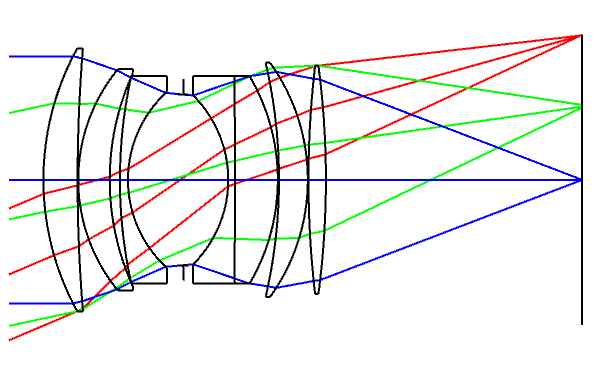
The optimization framing I referenced earlier applies here equally clearly. Lanthanum glass provided designers with another truly independent variable: optical power could now rise without a proportional increase in chromatic aberration. Each occurrence of such decoupling expands the design space slightly further, allowing an entire generation of new lenses to become possible almost instantly.
The Space Race and the Rise of Computer-Aided Design
By the 1960s, glass technology’s most demanding customer was no longer the camera industry at all. It was the space race.
Cold War defense programs and the drive toward orbital and deep-space astronomy introduced requirements that consumer photography never had to contend with: materials that would not deform under vacuum, that could survive violent temperature swings without warping, and that could resist the radiation environment of space itself. Corning answered part of this need in 1968 with ULE, ultra-low expansion glass, a titania-silicate formulation with a coefficient of thermal expansion so close to zero that a mirror made from it barely changes shape as temperature swings around it. ULE went on to become the material behind the Hubble Space Telescope’s mirror and, decades later, the primary mirror blank of Japan’s Subaru Telescope, the same telescope whose corrector optics we touched on when discussing Yoshiya Matsui in the names newsletter. More recently, that same near-zero expansion property made ULE glass a natural fit for the reflective optics used in extreme ultraviolet lithography, the technology behind the most advanced semiconductor chips being manufactured today. A glass invented to hold a telescope mirror steady against the cold of space turned out, a half century later, to be exactly what chipmakers needed to hold a mask steady against the heat of an EUV light source.
Alongside ULE, defense and aerospace programs drove development of radiation-hardened and thermally stable glass variants for satellite optics and guidance systems, along with specialized transmission windows built for wavelengths well outside what human eyes or ordinary photographic film ever needed: fused silica for deep ultraviolet work, chalcogenide and germanium-based glasses for mid-infrared imaging, and titanium silicate formulations tuned for early laser applications.
This same period saw the arrival of computer-aided optical design, through the 1960s and into the 1970s, which changed what was practically achievable almost as much as any single glass breakthrough had. Multi-element systems with aspherical and diffractive surfaces, calculations that would have taken a human with logarithm tables months to work through by hand, became feasible to optimize in reasonable time. This shift demanded a new level of glass consistency from manufacturers, since a computer optimizer will happily exploit tiny material inhomogeneities that a hand-calculating designer might never have pushed hard enough to notice, and it spurred further glass development in its own right: lanthanum-heavy flints, new high-index low-dispersion types, and coatings engineered to survive harsher environmental conditions. Glass manufacturers responded with formal certification programs and the international standards the industry still leans on today, including ISO 10110 for optical component specification and MIL-PRF-22475 for military-grade optical glass.
Part Three: The Frontier of Modern Glass
The Problem Lanthanum Couldn’t Solve
Even when they had lanthanum-era glass, designers still encountered a stubborn barrier: secondary spectrum.
Here’s the issue. A typical achromatic doublet brings two wavelengths, commonly red and blue, to the same focal point. That is how an achromatic lens is defined. A third wavelength, often in the green or yellow region, comes to focus at a separate point. That mismatch is called secondary spectrum. In photographs it shows up as faint color fringing. Digital adjustments cannot eliminate this effect. It stems from a physical property of the glass, not from a geometric error.
The key insight is that the Abbe number, the sole figure of merit we have used in this series to characterize dispersion, actually provides an incomplete picture of how a glass bends various wavelengths. Two glasses may share the same refractive index and the same Abbe number yet still disperse light differently across the spectrum in finer detail. This finer grained behavior is termed partial dispersion, and for most glasses, a plot of partial dispersion versus Abbe number yields a fairly tight, predictable curve known as the normal line. Any glass that lies on that normal line, regardless of selection, gives you roughly the same secondary spectrum issue, because they all disperse light in the same underlying pattern.
Schott, followed later by Ohara and Hoya, developed glasses that deviated markedly from the standard dispersion line. These were named anomalous partial dispersion glasses. These materials disrupted the correlation between the Abbe number and the acute dispersion behavior. This resembled the earlier way barium crown glass had separated refractive index from coarse dispersion. This advancement let lens designers correct the secondary spectrum instead of only primary chromatic aberration. Prior to this, primary chromatic aberration had been the limiting factor in lens design since the era of Dollond. These materials form the basis of every lens bearing an APO designation. When I discussed Peter Karbe’s APO-Summicron in the lens names newsletter, the term “APO” referred specifically to this chemistry. It denotes glass engineered to deviate from the normal dispersion line.
ED Glass: When Color Correction Stops Dominating the Optimization
Extra-low-dispersion, or ED glassis closely linked to the anomalous dispersion story, yet it deserves separate mention because of how it altered the process of lens design rather than merely the final outcome.
Before ED glass became widely available, correcting chromatic aberration to a high standard consumed a huge share of a designer’s available degrees of freedom. Curves, spacings, and element counts all had to be chosen partly in service of hiding color error, which meant less of that design budget was left over for attacking coma, astigmatism, and distortion. ED glass changed the balance of that trade. Instead of optimizing geometry to disguise color, a designer could remove a meaningful share of the color problem through material choice alone, freeing up the optimization process to spend its remaining effort on everything else.
Modern zoom lenses achieve markedly better performance than models from the 1970s and 1980s due to a particular, often overlooked reason. Although computer optimization grew more powerful, the improvement also stems from changes in raw materials. Newer glass types lowered the difficulty of chromatic correction. Since the glass managed color issues more effectively, the optimization software could concentrate on other aberrations that demand high computing power. Glass technology solved color problems, enabling optimization tools to tackle the remaining optical issues.
Fluorite: About as Close to Ideal as Glass Gets
If ED glass moved the needle, fluorite, whether natural or synthetic, moved it almost as far as physics currently permits. Fluorite crystal exhibits very low dispersion together with strongly anomalous partial dispersion, and this combination permits near‐ideal correction of the primary spectrum, the secondary spectrum, and spherochromatism (a more subtle aberration where different wavelengths don’t just focus at different points along the axis, but also suffer different amounts of spherical aberration) essentially all at once in a single material.
The practical effect appears most dramatically in telephoto lenses, where chromatic aberration has traditionally been most severe, simply because long lenses amplify every optical error along with the subject. Fluorite elements enable telephoto designs to be smaller, lighter, and sharper at the same time, because the material itself provides correction that would otherwise require extra compensating elements, and each element you can omit saves weight, cost, and transmission loss. If you have ever wondered why a modern 400mm f/2.8 is a truly usable, hand‐holdable (with effort) piece of equipment rather than the room‐filling brass tube a 19th‐century equivalent would have required, fluorite accounts for a large part of that answer.

Moldable Glass: Geometry Finally Catches Up to Chemistry
Throughout most of the narrative we’ve presented in this series, chemistry took the lead and geometry came after. When a new glass emerged, designers worked out how to use the additional freedom it provided. The introduction of precision‐moldable optical glasses in the later 20th century reversed part of that dynamic.
Many modern glass types can now be precision molded straight into aspheric or freeform shapes, instead of being ground and polished as spherical surfaces in the traditional manner. It may appear to be a manufacturing point, yet it is fundamentally a design issue: after molding proved reliable at scale, aspheres and freeform elements ceased to be a rare, costly, hand‐finished specialty (as with the Noctilux’s original hand‐ground element, a process we mentioned in the lens names newsletter) and turned into a standard design tool. Optimization now truly encompasses glass, geometry, and the manufacturing process at the same time, instead of treating manufacturability as an afterthought added to a completed optical design. This explains in part why compact cameras and phone lenses can reach correction levels today that, as recently as the 1990s, would have required a far larger and far more expensive lens.
The Digital Era: New Demands, New Constraints
The latest chapter of this story is being written at this moment, and it is shaped by pressures that would have been unrecognizable to Fraunhofer or even to Rudolph.
The rise of digital imaging has increased demand for high-refractive-index glasses that allow designers to keep lenses thin and light for smartphones, drones, and medical endoscopes, as well as for low partial dispersion glasses that reduce the chromatic errors that appear so unforgivingly on high‐resolution CMOS and CCD sensors, which are far less tolerant of color fringing than film grain ever was. Simultaneously, environmental regulations, specifically RoHS and REACH, required the phase‐out of lead, arsenic, and barium compounds that had served as standard glass ingredients for more than a century, thereby speeding the development of bismuth-, titanium-, and lanthanum‐based alternatives that omit those elements yet still meet the required optical targets. This constitutes a genuinely hard chemistry problem: substituting a toxic component without sacrificing the optical properties it supplied, and Schott, Ohara, and Hoya have each been addressing it methodically for the past two decades.
Precision glass molding, computer‐controlled annealing, and CNC finishing have also evolved into routine manufacturing tools rather than laboratory novelties, allowing aspheric and freeform surfaces without the traditional hand‐grinding that once made them a luxury feature. Glass itself now shares the field with genuine competition: plastics such as PMMA and polycarbonate, diffractive optical elements, single‐crystal substrates like sapphire and YAG, and even metasurfaces all represent viable options for particular applications today. Nevertheless, precision optical glass remains irreplaceable at the extreme end of the field. EUV projection optics used in semiconductor lithography still depend on ultra‐pure fused silica. Astronomical telescopes, high‐power laser systems, and biomedical imaging all continue to rely on glass chemistry that no plastic or metasurface can presently match. Current research is advancing into nanocomposite glasses, ion‐exchange stress engineering for increased durability, AI‐assisted composition optimization, and materials designed specifically for quantum photonic circuits and adaptive optics, an area that would have sounded like pure fantasy to Otto Schott, although he would almost certainly have recognized the underlying instinct driving it.
The Idea That Ties This Whole Piece Together
I want to conclude with a framing that, honestly, altered my thinking about this whole topic during the research.
It is tempting to recount this story as a list: crown and flint, then barium crown, then lanthanum, then anomalous dispersion, then ED glass, then fluorite, then moldable optics. It reads like a parade of increasingly superior materials. Yet I doubt that “better” is the appropriate word, or at least not the most useful one. A more accurate way to describe the evolution of glass is that the design space continued to expand bigger.
Consider the evolution of glass and optical design as an optimization problem, as a lens designer must. During Petzval’s era, there were roughly a dozen practical glasses, and almost all effort was spent shaping surfaces to balance the Seidel aberrations, since the choice of glass provided little freedom. By the time of Rudolph, glass selection had become a true design variable, not merely a constraint to be circumvented. Today, commercial lens design software treats glass as one of many parameters, alongside radii, thicknesses, air spaces, aspheric coefficients, and manufacturing tolerances, all optimized jointly.
The history of optical glass and lens design forms a single narrative. One aspect emphasizes chemistry, while the other emphasizes geometry. Lenses such as the Cooke triplet, the Tessar, the Planar, the Sonnar, and the APO-Summicron were not invented simply because designers grew smarter over time. These advances happened because glass researchers employed oxides and particular furnace temperatures rather than radii and Abbe diagrams, to provide designers with greater technical flexibility. Geometry and lens design forms are frequently credited for the advances in lens design (I’ve done that myself), the unique shapes that make zooms possible, and lens names that appear on the front rings. Nevertheless, the glass properties enabled these geometric designs to work.
That, I believe, is the true history of optical glass. It is not a parade of chemical formulas, but a gradual, steady expansion of what could be achieved mathematically, one oxide at a time.
For more deep insights on lens design, go check my Ultimate Guide on Lens Design Forms, and if this type of content interests you, please subscribe below.
Your FREE Ultimate Guide to Lens Design Forms
With this guide, you can:
-Get the ACTUAL lens designs data to use as a reference for your lens design
-Save valuable time in your lens design process
?-Get the fundamentals of lens design in an accessible format
This FREE ebook and lens design data will help you uncover the essential lens designs. It will show the concepts and strategies of lens design through essential lens design forms so that you can take control of your lens design.
We hate SPAM and promise to keep your email safe?100% privacy, and we hate spam. When you sign up, we'll keep you updated usually with one email per week, occasionally up to a few times a week. Unsubscribe at any time.
Leave a Reply